What do you do when your child blurts out the meanest thing in the carpool line or refuses to share the last cookie with their sibling? You cringe, of course, and you wonder “Where did that come from? Don’t they know better?”
But prosocial behaviors like kindness, cooperation, empathy, and respect aren’t instant habits. Telling a child to “be nice” doesn’t actually teach them how it’s done. Qualities like these develop slowly, like learning to read or ride a bike, through repeated practice and real-life situations. Elementary school years are especially important because kids are stretching their independence, clashing and connecting with peers, and discovering that the world doesn’t always bend to their wishes. It’s messy, but that’s exactly where the learning happens.
At Kong Academy, we treat prosocial behaviors as more than a buzzword. To us, they’re the everyday choices that help kids grow into resilient, capable humans who can get along with peers and eventually thrive in the wider world. The best part is that kids don’t have to sit at a desk to learn these lessons. When they’re moving their bodies, caught up in a game, or swept into a silly adventure, they’re actually practicing empathy, cooperation, and respect without even realizing it. What might feel like playtime on the outside is where some of the deepest social learning takes root.
Strategies To Try At Home & Beyond
These ideas are designed to work just as well around your dinner table as they do in the park or classroom. They’re also the same approaches we weave into every activity at Kong Academy, so kids are getting consistent practice no matter where they are.
1. Model what you want them to mirror
Kids watch everything. If you roll your eyes at a neighbor, they notice. If you thank the barista and hold the door for a stranger, they notice that too. Modeling prosocial behavior is showing kids that empathy and respect are lived values, not just words.
And when you slip up, because you will, owning it, apologizing, and repairing the moment teaches them more than any lecture will ever do. That’s where kids see humility and responsibility (two big building blocks for healthy relationships later on) in action.
At home, you can make these choices visible by narrating them out loud like, “I was frustrated, but I took a breath before answering.” When parents share their process, kids get a playbook they can borrow for their own sticky situations.
2. Practice cooperation through play
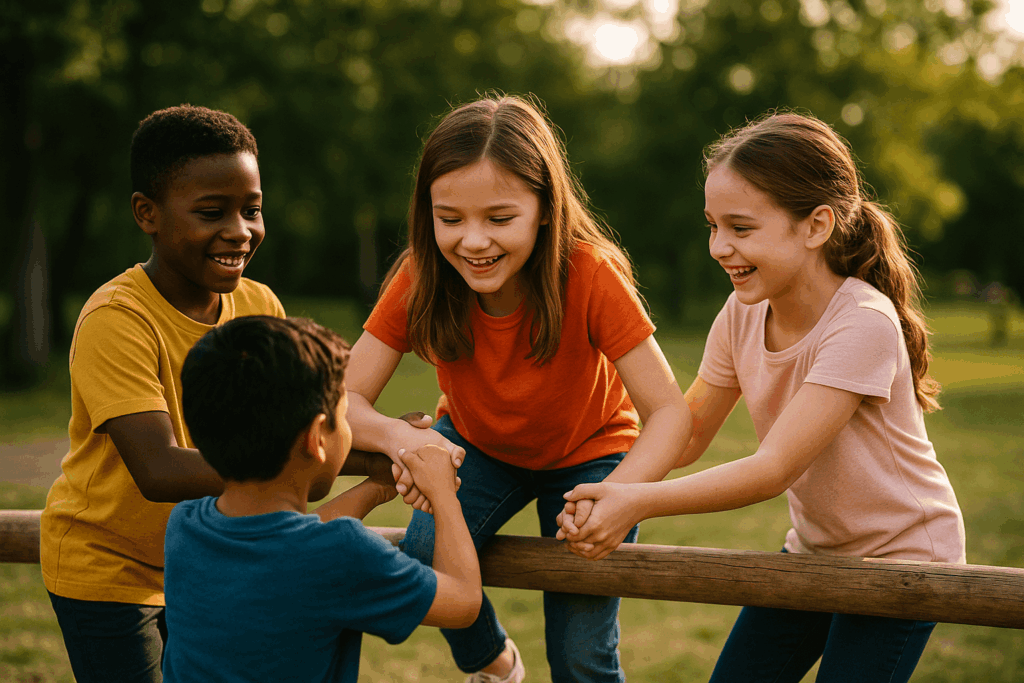
Children learn best when their whole bodies are engaged. Prosocial behaviors like sharing, taking turns, and problem-solving show up naturally when kids are climbing, running, or role-playing superheroes together.
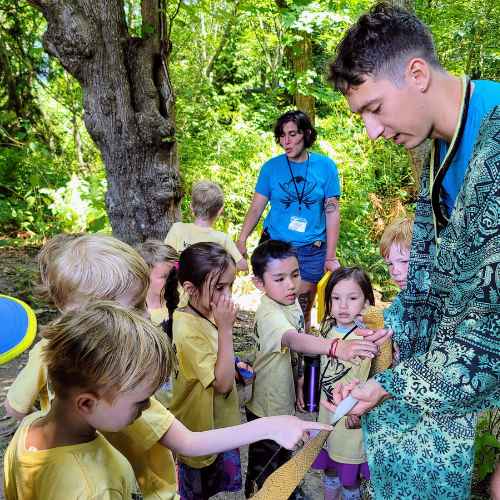
At Kong, we use activities like team relay races, obstacle course challenges, or even group juggling with beanbags to show that people matter more than the game. Kids discover that helping a teammate who drops the baton is just as valuable as crossing the finish line.
At home, you might try cooperative board games where everyone works together to solve a puzzle or beat the clock. These kinds of activities let kids practice waiting their turn, dealing with frustration, and sometimes losing gracefully, all while still feeling connected as a family.
3. Encourage perspective-taking
Empathy can feel abstract to a 7-year-old, but it starts with something simple like, “How would you feel if that happened to you?” When kids are nudged to see from another’s point of view, they begin to stretch beyond their own needs and impulses.
And because perspective-taking can be tough in the heat of a sibling squabble, it helps to practice when the stakes are low. That’s why silly games and stories work so well. Pretend play gives kids a safe place to test-drive another role, while storytelling lets them imagine how someone else might feel in a tricky moment. Even switching roles at home, “You be the teacher, I’ll be the student!” can slow things down long enough for a child to notice what it’s like to stand in someone else’s shoes. Each of these playful experiments gently stretches their ability to see the world beyond their own point of view.
At Kong, we encourage kids to act out their favorite ninja, animals, and superheroes characters so they can step into another role and feel what it’s like to think or move as someone else. These imaginative leaps build empathy muscle in ways that stick far beyond the game.
4. Teach healthy risk-taking
It might not sound obvious, but prosocial behaviors also grow when kids learn how to manage risks together. Think about it, building a fort, climbing a tree, or even negotiating the rules of a made-up game all involve cooperation, compromise, and trust.
At Kong, we design challenges where kids push limits physically and socially, while still having the safety net of peers and caring adults. When a child realizes they can take a leap and their friends are cheering them on, prosocial bonds strengthen in powerful ways.
At home, this might look like letting your child plan a new route to school, or work with a sibling to bake a messy cake. When they succeed, or even fail together, they practice collaboration, encouragement, and trust.
5. Normalize conflict and resolution
No group of kids is going to get along perfectly all the time, and that’s actually a good thing. Conflict is where social behaviors get tested. Instead of swooping in to fix every fight, guide kids to use words, listen to each other, and find solutions.
At Kong, games offer built-in opportunities for this. Disagreements about rules, roles, or outcomes are chances to practice conflict resolution without it feeling like a lecture. And because kids are motivated to keep playing, they’re more open to working things out.
At home, you can model this by coaching them through the steps: pause, listen, state your needs, and brainstorm solutions. It’s slower, yes, but those conversations pay off in resilience and relationship skills.
6. Celebrate small wins
Prosocial behaviors don’t have to be grand gestures. A high-five, a “thank you,” or giving someone else the last turn all count. When you point out and celebrate these moments, kids realize their actions matter. And that sense of pride fuels more of the same.
At Kong, we highlight effort and persistence as much as outcomes, because those are the seeds of a growth mindset. When kids believe their choices can create positive change, good social habits become second nature.
At home, this could look like praising your child for helping a sibling, not just for finishing homework. Reinforce the effort, and they’ll build confidence in being kind and cooperative.
Pulling It All Together
Prosocial behaviors need practicing and reinforcement, not perfection. Your child won’t always get it right, and neither will you. But through modeling, playful cooperation, and safe chances to try again, kids slowly learn the skills that make friendships easier and classrooms calmer.
And if you’ve ever wished you had more support in helping your child grow these skills, that’s where we come in. At Kong Academy, our after school programs, summer camps, and Kids Club give children countless opportunities to practice empathy, cooperation, and respect, all wrapped inside of games, movement, and adventure.
Because raising kind, capable kids isn’t something you have to do alone. We’re here to help your child grow strong in every way.



7-Day Crystal Shard Adventure
Unleash your child’s potential with our 7-day crystal shard movement adventure!